
The Property Score That Killed The Sales Pitch
Most deals are dressed up. Here's the system we built to see through it.
I've been on both sides of this industry long enough to know ALL of the sales tricks: almost any property can be made to look like a great deal if you control the assumptions.
Lowball the vacancy rate...
Underestimate maintenance...
Use unrealistic rental rates to push the cap rate.
Suddenly a mediocre property has a "great" cash-on-cash return...and you don't find out it was fiction until you own it.
That is a horrible feeling.
I should know because my first experience with turnkey investing was with a few different shops in the southeast that sent me deals that on paper looked incredible.
I remember thinking to myself, how can I go wrong with this?
Well...Trust me... PLENTY can go wrong with real estate investing and for me the biggest frustration was the minute we signed on the dotted line and the money was in their bank account, the maintenance requests and vacancies started adding up quickly and before I knew it, I realized that I had just inherited another investor's problem properties.
So when I say that I know all of the tricks of the trade...Believe me, I have experienced the good, the bad, and the very ugly and so my goal in creating a turnkey business for investors was to make sure that above all else I was transparent with investors so they knew exactly what they were getting.
Why I Built the Property Rush Investment Score
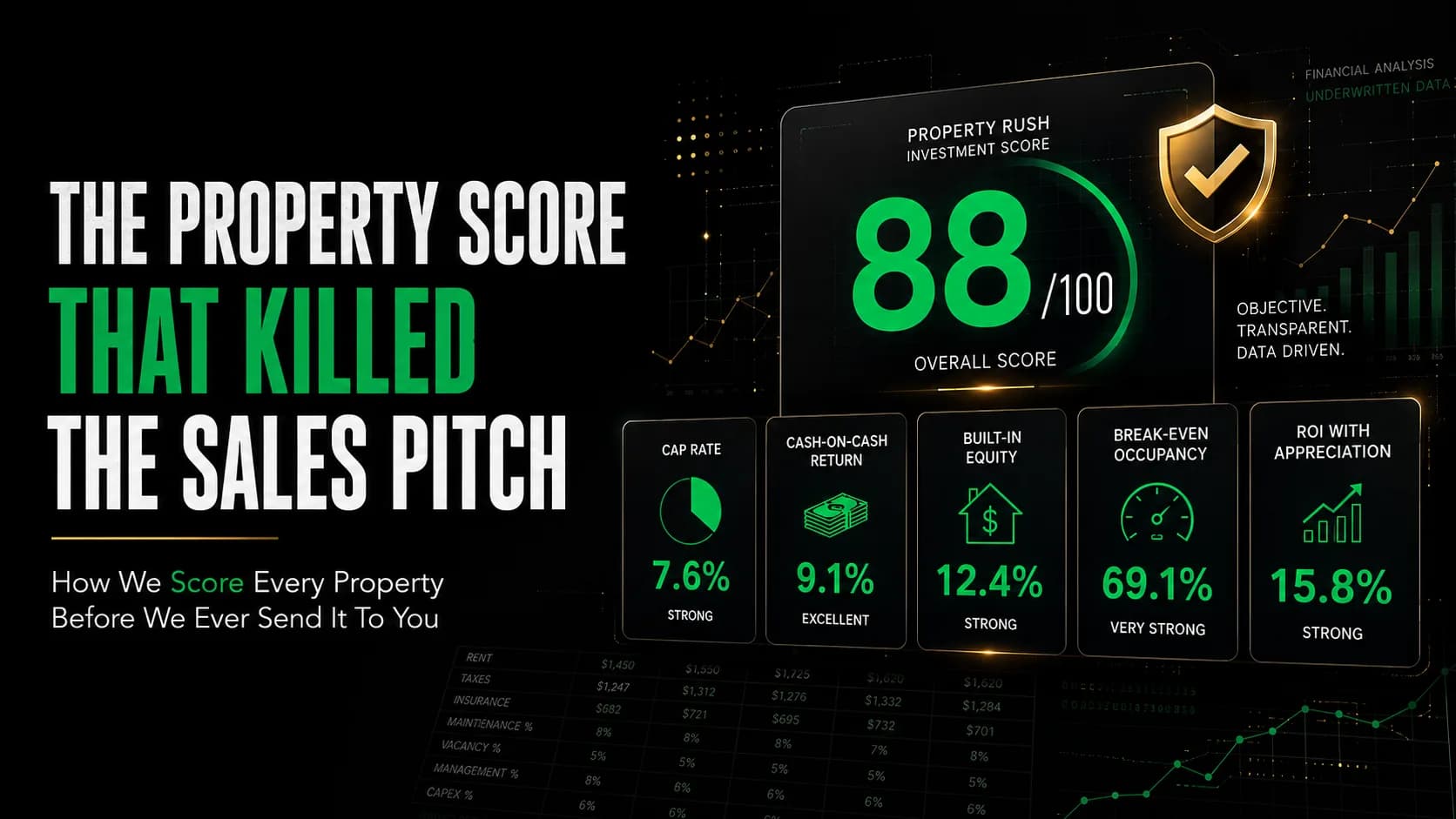
That's exactly why I built the Property Rush Investment Score.
With the recent major improvements in AI, my dream of creating a scorecard for properties based off of the numbers and not off of emotions is now possible. And the results have honestly blown me away.
We built a repeatable calculation that speaks for itself.
Numbers don't lie and this scoring system is proof of that.

How the Score Works
1. Every property runs through the same inputs.
No property gets a custom-favorable assumption. Every single deal, regardless of who's selling it or how much I want it to move, gets scored on the same fixed set of inputs.
I made sure to include every factor imaginable when underwriting a property: purchase price, ARV (After Repair Value), monthly gross rent, annual taxes, annual insurance, maintenance %, CapEx %, vacancy %, and management cost. If a property can't hold up under the standard assumptions, it doesn't get a high score just because someone got creative with the spreadsheet.
2. The financing terms are locked, not cherry-picked.
Every score is run on the same structure: 25% down, 6.5% interest, 30-year amortization, 3% closing costs. That matters more than people realize. A deal can look incredible at 10% down and a teaser rate, and mediocre at real-world terms. Locking the financing means you're comparing properties to each other, not comparing creative financing assumptions.
3. The score is a formula, not a feeling.
Five hard numbers roll into the composite score, each doing a specific job:
- Cap Rate — the return the property generates on its own, before any financing games
- Cash-on-Cash Return — what you actually feel in your bank account against what you put in
- Built-in Equity % — proof you're buying below true value on day one, not just hoping for appreciation later
- Break-Even Occupancy — how much vacancy the deal can survive before it stops paying for itself. This is the number that catches deals that only work if everything goes right.
- ROI with appreciation — cash flow, loan paydown, and appreciation blended into one weighted return
Each one is calculated straight from the raw underwriting numbers. No discretion, no "adjusting for potential." The score is a direct output of the inputs. Change the inputs and you change the score. Nobody's thumb is on the scale.
4. It's the same test I'd want run on a deal being pitched to me.
If a property can't score well once vacancy, maintenance, and real financing terms are applied honestly, I don't want it in front of you, no matter how good the story sounds.

See It In Action
A few from our current pipeline that hold up under this test:

Notice 2290 Malibu has the lowest built-in equity of the three but still scores near the top, because it wins hard on cash-on-cash and has the safest break-even occupancy of the group.
That's the point: no single flattering number can carry a property to a high score if the rest of the picture doesn't hold up.
The 3 Questions to Ask Any Seller
Want to sanity-check any deal yourself, ours or anyone else's? Ask these three:
- What's the cap rate?
Cap rate strips financing out of the equation entirely, so it doesn't matter if the deal is cash or leveraged. It's the purest apples-to-apples comparison there is. Anything under 6.5% is questionable to us. We rarely list a property below a 6.5% cap unless it's new construction or there's massive built-in equity offsetting it. - What vacancy rate did they use?
If it's under 5%, ask why. Real-world vacancy rarely runs that low. - Does the property survive a bad month?
If break-even occupancy is above 85-90%, one vacancy or one slow-pay tenant wipes out the cash flow. That's not a deal, that's a bet.
Any seller who can't answer those three plainly is selling you a story, not a number.

Why There's No Perfect 100
So why do you not have any properties with a perfect score of 100/100?
You will never find a perfect score because that would assume a PERFECT property. Which we all know is not reality.
If a property were to score 100 it would have to meet this criteria:
Financial Performance (36/36) — Cap Rate 7%+, COC 6%+, Break-Even under 75%
Equity & Value (17/17) — Built-in Equity 12%+, currently occupied
Property Quality (28/28) — All 4 core systems fully new (HVAC, Roof, Electrical, Plumbing) plus every bonus item (kitchen remodeled, all bathrooms, new siding/windows, crawl space, new flooring), renovated/built within the last year, AND brand-new construction (the 5-pt bonus)
Location (5/5) — School rating 7-10
Now you can understand why a score in the high 80's is an incredible opportunity. That means over 80% of the criteria above has been met and the opportunity is a great one.
Next week: how we take properties like these and blend them into a diversified portfolio, the way you'd build a fund, not a single bet.

Current Pipeline
Ready to see deals that actually hold up?
Every property in our inventory has been run through the Property Rush Investment Score. No stories. No dressed-up numbers. Just deals that hold up under real-world assumptions.
View Current InventoryNo obligation. Every deal comes with the full score breakdown.

More from Investing
All posts →
A Rare New Construction Opportunity in Ringgold, Georgia
New construction. 4 lots remaining. Real numbers inside. Don't wait.

Are You Serious About Building a Real Estate Portfolio?
This is for a very specific type of investor.

Property Rush Portfolio Partners
A more personal and strategic way to build your real estate portfolio.