What Down Payment Do You Actually Need?
You don't need $150,000 to start. Here's what you actually need.
The number that stops most people before they even start is the down payment.
They hear “investment property” and immediately assume they need $150,000 sitting in a savings account somewhere.
So they wait. And wait. And tell themselves they’ll get into real estate someday.
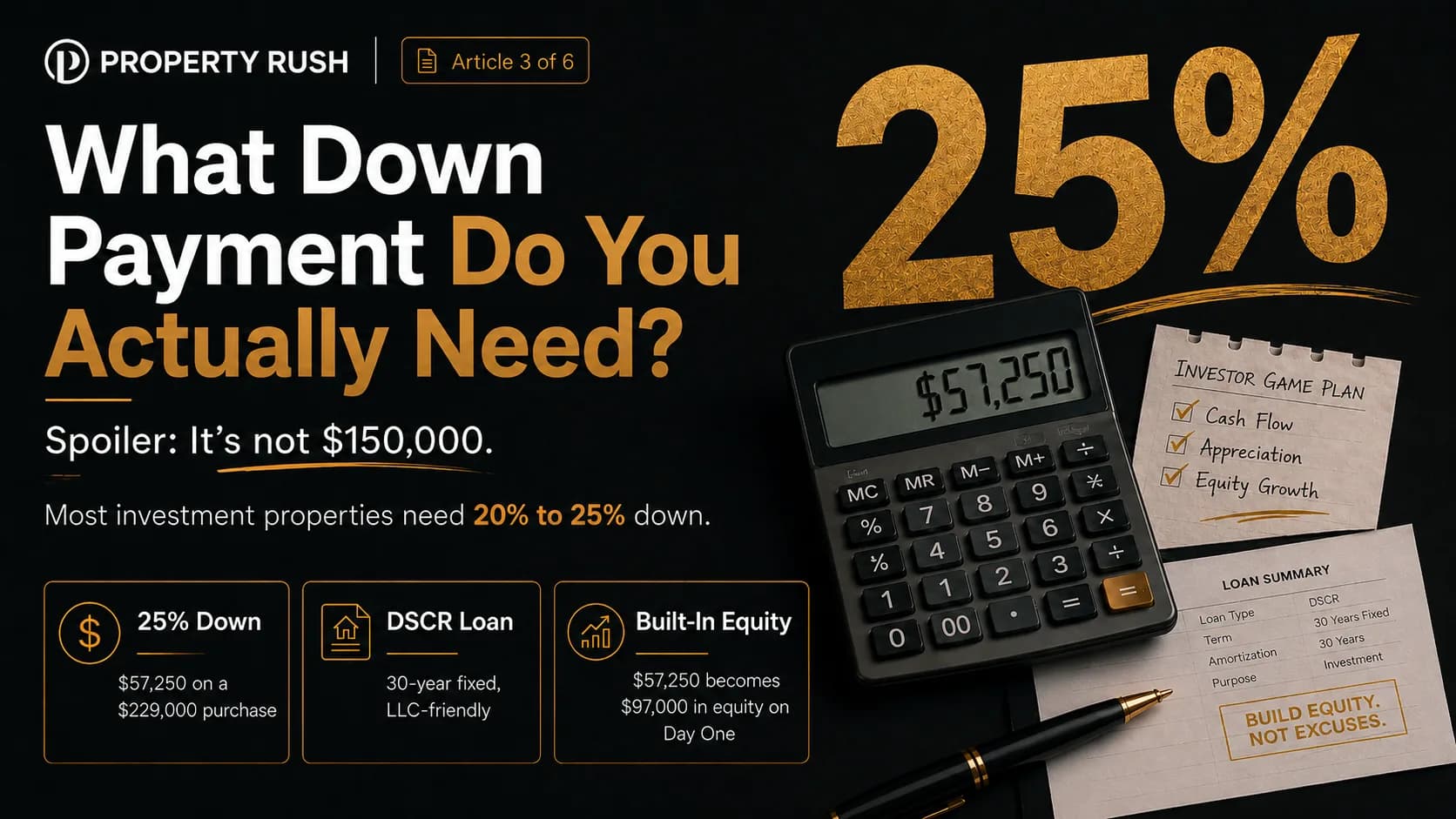
Here’s the actual number. For a conventional investment property loan, you’re looking at 20% to 25% down.
These days, most investors — myself included — use a DSCR loan instead.
It gives you the best of both worlds: a 30-year fixed rate and solid terms, plus the ability to purchase under an LLC.
Best part?
You don’t need to be a W-2 employee to qualify.
The underwriter looks at the property's own numbers, more specifically the properties ability to service the debt. Hence the name DSCR (Debt Service Coverage Ratio).
The lenders want to make sure that when the property is leased out that the rent will exceed the mortgage with some to spare.
The ratio is generally 1.3x but varies depending on the lender. This is a really big deal for entrepreneurs or sales people who do not have a long history of steady w2 pay.
That barrier is no longer an issue with the DSCR loan guidelines!
For example: 25% down payment on a $229,000 house like 321 Whitmire Tunnel Hill is $57,250.
Not nothing. But not $150,000 either.
Where That Money Can Come From
A lot of first-time investors assume it has to come straight from their savings account. Sometimes it does. But there are a few other options worth knowing.
Your primary home’s equity.
If you’ve owned your home for a few years and it’s appreciated, you may be sitting on more usable equity than you think.
A HELOC — a home equity line of credit — lets you borrow against that equity, often at a reasonable rate. Some investors use this to fund their first down payment, then pay the HELOC down with rental income over time.
A cash-out refinance on your primary home.
You refinance your existing mortgage, pull cash out, and use it to invest. This one requires more deliberate planning but it’s a real path.
Straightforward savings.
If you earn $80,000 a year and you’re intentional about it, setting aside $1,500 a month gets you to $57,000 in about three years. That’s not fast. But it’s not impossible either. And three years goes by whether you’re saving or not.
A self-directed IRA or 401k.
Some retirement accounts can be redirected into real estate, but the rules are strict and the penalties for getting it wrong are steep. This one isn’t DIY — talk to a CPA before you touch it.

The Part Nobody Talks About
When you buy a property with $40,000 in built-in equity (like 321 Whitmire) your down payment is doing two jobs at once.
It’s getting you in the door. And it’s sitting on top of equity you didn’t have to earn separately. The day you close, your net worth went up $40,000. Your $57,250 investment immediately has a real equity position of close to $97,000.
That’s why buying right matters more than almost anything else. The deal itself is part of your capital strategy.

What to Avoid
Don’t tap your emergency fund.
Don’t drain your retirement accounts without fully understanding the tax consequences.
And don’t buy a property just because you scraped together the minimum — if the deal isn’t right, the down payment is just the beginning of your problems.
Buy when the deal is right.
Buying right once beats buying wrong three times.

|
| Browse Current Properties |
|
A NOTE FROM BJ BJ Gremillion Owner · Property Rush · 15+ Years in Real Estate |
||
|
||
|
No pitch. No pressure. Just a real conversation about your goals. Book a Free 15-Min Call with BJ |